
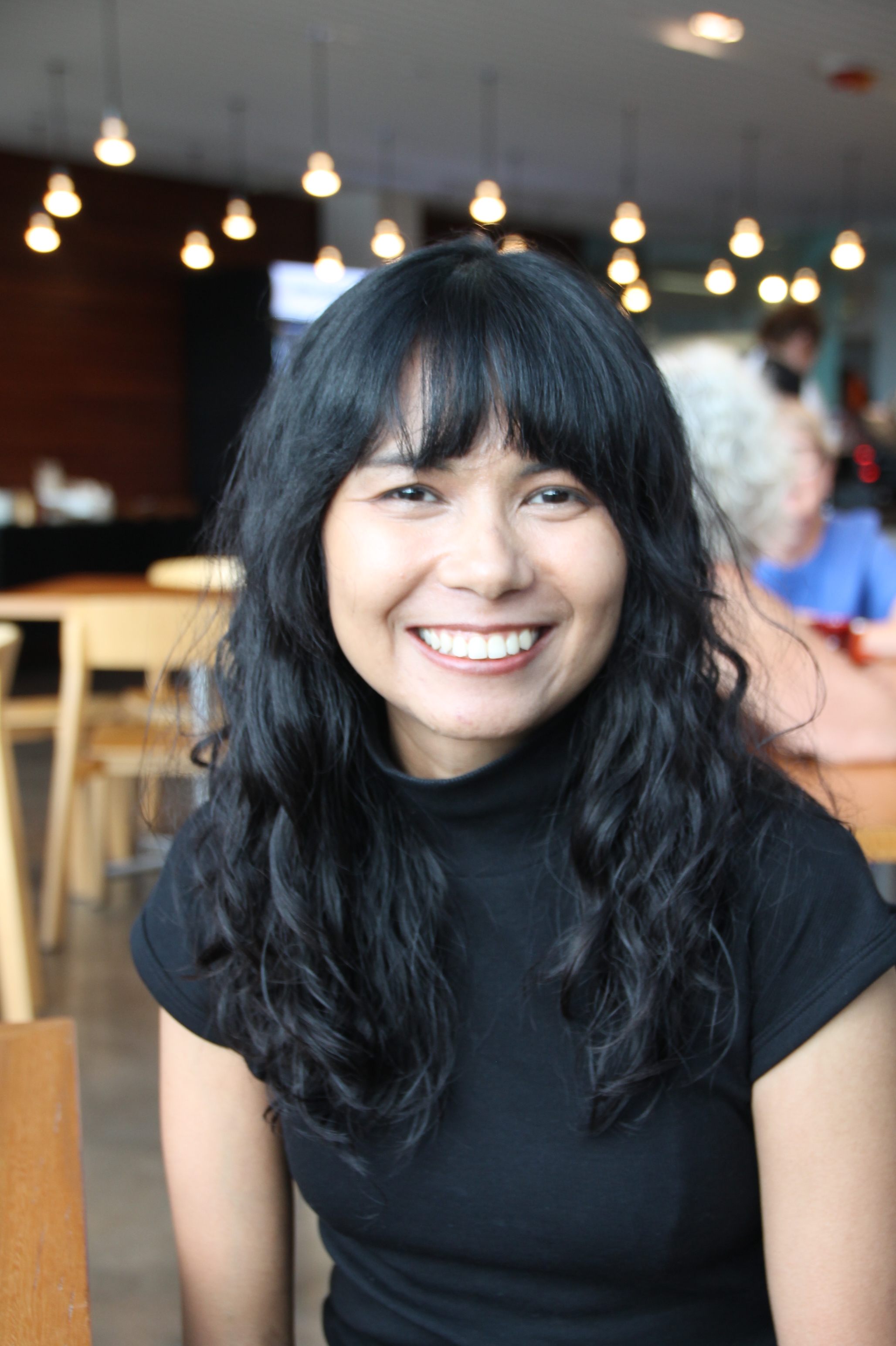
photo by Cynthia Webb, Brisbane, QLD, Australia
The Cinematheque is showing a retrospective of Kamila Andini’s feature films and short films, so far.
Empathy, intuition. These are the keywords to unlock the code that takes us to Kamila Andini’s film-making pathway.
She says it herself: “When the stories find me, and they are not complete but come to me organically as I work.” The way Kamila told it on Saturday 8th February, 2025, at the Cinematheque, at the Gallery of Modern Art ( GoMA) in Brisbane, Queensland, Australia, she clearly works in an ultra-feminine way and puts her trust in her own empathetic nature, and also in the way of womanhood. These meaningful stories of the lives of women and children, in a traditional society, reveal themselves to her.
Indonesia is extremely 21st Century/modern, and yet this booming and rapidly modernising economy, exists alongside the old traditional ways of the land, which still have a strong influence.
I thought of the male dominated Hollywood way of thinking, where they want a “pitch” that tells them everything, and they want it fast! I mentioned to Kamila ( Dini, as I call her), that her way of working would not go over too well in Hollywood mainstream scene. She laughed and knew it was true. Now is a good time to mention that I have known Kamila Andini since she was in her early teens, as she is the daughter of my friend Garin Nugroho, a highly respected Indonesian film-maker, from the era, back before “Reformasi, 1998), who made ‘risky business’ films, during the time of the military dictatorship of President Suharto. However, I must mention that Garin Nugroho has never been more active in film and theatre than right now!
At the GoMA Cinematheque last weekend, Dini spoke of her teenage days when she was the only one at school who had a father who was a film director. When her friends asked questions about film-making and she didn’t have all the answers, she realised that she had a unique opportunity, and made it her business to become informed about film-making in Indonesia, during those days. When I first met her she was working after high school days, at her father’s downtown Jakarta, Film Studios…and here she learned the technical things, and maybe absorbed the lore and magic of The Cinema.The precious gift of love for cinema infected her!
It is clear to me after observing her progress, her professional development, and her personal life, that she has a strong talent. Here is a young woman who has within her, a talent for visualising a concept and then creating very moving cinematic stories, of the people of her land and water, as they say in Indonesia. Dini’s first feature film, ‘The Mirror Never Lies”, was about “the Water” side of Indonesian life – about the Sea Gypsies, or Bajau people. They are a very small number within the total Indonesian population of 280 million.
However, Dini has made a completely personal cinematic journey. After all, she is a young woman. When she made her first film she was still ‘single’ and as she told me about it one day in Jakarta, she was asking if she should submit it to the Asia Pacific Screen Awards in Australia… This was “The Mirror Never Lies”. After I had the opportunity to see it, I advised, “Yes, yes, yes, because you could quite likely win a major award with this gorgeous film!” And sure enough, that is what happened. The award for Best Youth Feature Film in 2012 went to “Laut Bercermin”/ “The Mirror Never Lies”, which was a very unique piece of work, shot on location in Wakatobi, South Eastern Suluwesi, in a rare and never before seen on film location – a village of the Sea Gypsies, or Bajao people… who live a life completely from the sea, in the sea, over the sea, in the waters of Indonesia, the Philippines, and Thailand. These people have deep knowledge of the sea, extraordinary abilities relating to the sea, and bamboo houses on stilts that are built on coral reefs, which are covered by tropical waters. The film is extremely valuable as an anthropological record of a fast disappearing way of life.
By now Kamila Andini has made four feature films and several short films too.
She married another film-maker, Ifa Isfansyah in April, 2012, and now they are the parents of two daughters. Dini told the audience at the Brisbane Cinematheque, about how after the birth of their first daughter, she spent around nine months, at home loving every minute of being a mother . Then an opportunity came up for her, to work on a short film and after discussing with Ifa, her husband, she took up the chance and found herself back on set making another film. She observed herself closely, and was totally surprised to see that she was over-joyed to be in the director’s chair again. She loved this film-making life, as much as she loved the life of Motherhood.
Since then she has successfully combined her two lives, film writer/director, and mother of two daughters. Her husband Ifa Isfansyah has mostly taken the role of producer, but during their exciting opportunity to make a Series for Netflix Asia, “Gadis Kretek” (“Cigarette Girl”) they both directed during the five episode series which was a huge success in Indonesia. This was an adaptation from a novel, which Ifa Isfansyah had dreamed of filming during the years since its publication 2011.
Returning to my opening remarks about Dini’s empathy and intuition… these are 100% the motivation and feminine power that enables her to create her films, both the feature films and the short films. As a young woman and mother, of Javanese descent and upbringing, and brought up in the culture of Java, she inherited a great depth of cultural wisdom which she combined with her life as a modern young woman growing up in a nation traversing massive social change, which particularly changed the lives of women. With these two different but rich Indonesian experiences which she lived through in her lifetime, Kamila Andini arrived at adulthood with a powerful awareness, understanding and vision. She used these gifts that came to her because of her lucky time to be born, and being lucky enough to be the daughter of Indonesia’s most well known film-maker of the times that included the dramatic period of Reformasi. (Reformation/Revolution). With her innate gift of visualising a film which can tell a story of young women of her generation, she makes films which speak of the complex changing times she lived through, along with her own entire generation of young women.
Indonesia has undergone immense and rapid social and political change during Kamila’s lifetime, and this has brought a huge store of “issues” to be faced by contemporary women of these times… Kamila’s times.
Kamila told the audience in the Cinematheque about the way that her subjects for a new film find her, come to her from “out there” in the society around her, and about how she then begins receiving and writing the story – as if it were channeling its way to her from within her own Society. It was made clear how her sensitive films about women and children and their experiences in contemporary times, are so true, so real, so empathetic! Yes, the source of Kamila’s inspiring screenplay concepts, is the richness of her homeland, Java, Indonesia. Empathy is her connection to all the delicate stories of the past and present and even the future is not out of reach for her. In traditional cultures, the heroes in the history books are all men, however Kamila knows that the women and children are heroic too, and that their experiences are every bit as important as the exploits of the more obvious male heroes that Indonesian children learn about.
Having already had considerable success in Asian Film Festivals, and also a breakthrough at the Toronto Film Festival, with “Sekala Niskala”, Kamila now has support from the Hubert Bals Foundation to make her next film, which I am confident will be another ‘treasure’ of Asian Cinema, and not to be missed under any circumstances!
Copyright, Article and photo of Ms Kamila Andini, February, 2025, Cynthia Webb


 cynephilia